
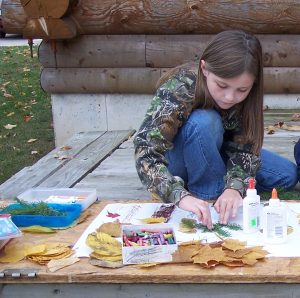
 Growing up, fall might have been my favorite season. I loved the change in weather, the colored leaves, and the return to school routines after busy summers of swimming lessons and soccer games. One core memory involves taking a hike through the woods with my mom and siblings, coming back with handfuls of leaves to organize and identify on a giant piece of paper. Of course, we also did leaf rubbings, trying our best to find a crayon that accurately matched the color of the leaf in question. My mother ended up putting her Forestry degree to good use as a homeschool parent, teaching her kids how to identify trees by leaf and bark. However, you don’t need to have studied an ecology field in college to teach science to your children! Here are five fun ideas on how to make getting outside this autumn both fun and educational:
1. Collect leaves from the trees around your local area and identify them!
Are they different colors? Different shapes? And yes, coniferous (evergreen) trees have leaves too, though they are commonly known as needles. If you want to be crafty, you can press leaves in a heavy book (note: this will not work with coniferous needles). You can also make leaf rubbings (younger age groups love using crayons for this!). Whatever you do with your leaves, use this seasonal opportunity to discuss why leaves change color in the fall, and do your best to identify which leaves belong to which tree. To engage your older students, you can also label your leaf rubbings to study the parts of a leaf.
2. Grab some graph paper, and keep a log of high and low temperatures as the season changes from summer to fall.

Depending on where you live, this could show a very dramatic shift in temperatures! If you are an overachiever, you can also keep record of barometric pressure and how much/how little precipitation you get. This is a great way for kids to practice making graphs – a skill used all the time in math and science!

3. Harvest your garden (if you have one) or find some produce at a local farm!
Traditionally, fall is the season of harvesting and preserving food for the winter. This can be an opportunity to learn about history/cultures, food/nutrition, and botany – all in one activity.
4. Go for a fall-themed scavenger hunt in nature.
This activity works well in large groups, such as other homeschool friends or a co-op! You can use our Fall Scavenger Hunt Guide as a starting point, then add your own ideas to the list to add a personalized touch based on your location.
5. Turn pumpkin carving into a botany project.
High school biology students often dissect animals, so why not plants too? Do some investigating to decide whether pumpkins are fruits or vegetables (this could be part of your experiment’s hypothesis), examine the seeds, and more.
For more fun family ideas for this season, check out Lillie’s blog post from last year on a September Fall Bucket List. No matter where you live, fall is a time of change and preparation. Schedules shift, and so does the weather. How will you use this season to explore nature in your homeschool journey?


